






September Astronomy Calendar and Space Exploration Almanac
The Year of the Solar System
NASA announced on Oct. 7, 2010 that the upcoming year would be "The Year of the Solar System." The “Year,” however, is a Martian year and, as such, 23 months in length. Some of the highlights of the “Year” of exploration are:
| Date | Mission | Status | |
| November 4, 2010 | Deep Impact encounters Comet Hartley 2 | Successful rendezvous | |
| November 19, 2010 | Launch of O/OREOS, a shoebox-sized satellite designed to test the durability of life in space | Ground stations receiving data | |
| November 19, 2010 | Launch of an experimental solar sail (NanoSail-D) aboard the Fast Affordable Scientific and Technology Satellite (FASTSAT) | Delayed separation from FASTSAT, deployment on 20 Jan 2011, appears operational | |
| December 7, 2010 | Japan's Akatsuki (Venus Climate Orbiter) spacecraft to enter orbit around Venus | Spacecraft failed to enter orbit and is now in orbit around the Sun | |
| February 14, 2011 | Stardust NExT encounters comet Tempel 1 | Successful rendezvous | |
| March 17, 2011 | MESSENGER enters orbit around Mercury | First spacecraft to achieve orbit around Mercury; see http://messenger.jhuapl.edu/ | |
| March 18, 2011 | New Horizons spacecraft crosses the orbit of Uranus | 4+ more years to Pluto; see http://pluto.jhuapl.edu/ | |
| July 16, 2011 | Dawn spacecraft to arrive at the asteroid Vesta | Orbit achieved; see http://dawn.jpl.nasa.gov/ | |
| August 5, 2011 | Launch of the Juno spacecraft to Jupiter | Successful launch/deployment; see http://missionjuno.swri.edu/ |
|
| September 8, 2011 | Launch of the GRAIL spacecraft to map the gravitational field of the Moon | ||
| Nov 8, 2011 | Launch of the Phobos-Grunt sample-return mission | ||
| November 25, 2011 | Launch of the Mars Science Laboratory (MSL) | ||
| August 2012 | MSL lands on Mars | ||
Other notable events:
August 9, 2011 Opportunity reaches the rim of Endeavour crater
October 8, 2011 2nd International Observe the Moon Night
March 3, 2012 Mars at Opposition
May 20, 2012 Annular Solar Eclipse (visible in southwest U.S.)
June 6, 2012 Venus Transit
Telescope Maker Extraordinaire
Ms. Cecilia Page, a teacher at the Hill & Plain elementary school and a McCarthy Observatory volunteer is now an award-winning amateur telescope maker. Cecilia started out by taking winter classes offered by the Springfield Telescope Makers in Springfield, Vermont. Over 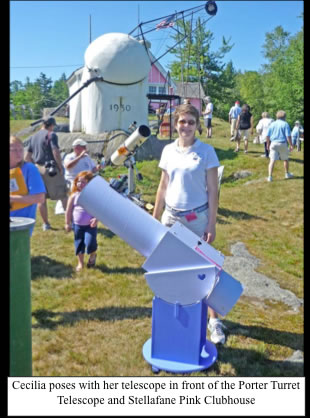 many months of grinding and polishing, her eight inch diameter mirror slowly took shape.
Once Cecilia had shaped the glass into the desired figure, a reflective coating needed to be applied to complete the mirror. Mr. Greg Ruthven, Director of Operation at Goodrich in Danbury, Connecticut generously agreed to have the optics tested and a reflective coating applied at their state-of-the-art optical facility. Mr. Tom Heydenburg was instrumental in making this possible, testing the mirror, and in overseeing the process (along with Mr. Robert Poirier, the coating engineer). This collaborative arrangement resulted in an exceptional reflective surface; however, it was the many hours of work by Cecilia that transformed a piece of raw glass into a honed collector of starlight.
A telescope is only as good as its mount. Cecilia chose a “Dobsonian” (altitude-azimuth) design, as shown in the photo (check out the artistic touches). Following the plans available on the Stellafane website,* she designed and constructed a mounting system for her mirror. Her effort was recognized when she entered her telescope in the design competition at the 2011 Stellafane convention (one of the largest gatherings of amateur telescope makers in the country). Not only did Cecilia’s telescope place third in the “Mechanical Design” category, it placed first in “Optical Quality” (for mirrors <12” in diameter).
Cecilia Page is just one of several amateur telescope makers that are active at the McCarthy Observatory (her daughter Katie is also working on a mirror). With several more mirrors and telescopes in the pipeline, expectations are sky high.
Be sure to check out Cecilia’s telescope at Second Saturday Stars.
“Out the Window on Your Left”
It’s been 39 years since we left the last footprint on the dusty lunar surface. Sadly, as a nation founded on exploration and the conquest of new frontiers, we appear to have lost our will to lead as a space-faring nation. But, what if the average citizen had the means to visit our only natural satellite; what would they see out the window of their spacecraft as they entered orbit around the Moon? This column may provide some thoughts to ponder when planning your visit (if only in your imagination).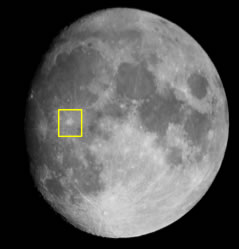
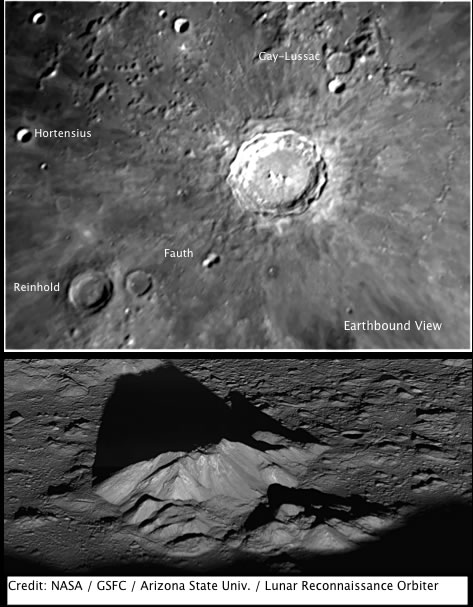
The view this month is of the crater Copernicus. It is one of the more notable craters on the Moon with its large size (58 miles or 93 km in diameter), prominent location and stark surroundings.
Copernicus is named after the Polish mathematician and astronomer, Nicolaus Copernicus. It is a classic complex crater with a broad, relatively flat floor, central peaks and terraced crater walls. Where it deviates from the “model” is in its depth. The floor of Copernicus is too shallow, and its central peaks too low, by 0.7 km. In a crater as young as Copernicus (less than 1.0 billion years old), it is unlikely that it was flooded by volcanism. As such, the process that partially filled the crater remains a mystery.
As with most young craters, Copernicus is surrounded by a system of bright rays. These splashes of ejecta extend radially away from the crater up to 700 km across the adjacent maria. The rays are most notable when the Sun is high in the lunar sky. They are comprised of bits of bright highland material (crushed rock) excavated by the original impact. Over time the brightness will fade as the lunar regolith is “gardened” by impacts of micrometeorites and “weathering” by cosmic rays and the solar wind.
Copernicus is located just south of Mare Imbrium and the Carpathian Mountains. The image at the top of the next page was taken with a camera mounted on a C-11 telescope. The rim of the crater rises over 1 kilometer above the surrounding mare and is illuminated by the rising Sun, as are the central peaks formed by the rebound of the rock compressed by the impact.
The image at the bottom of the next page was taken by the Lunar Reconnaissance Orbiter (LRO). In a rare oblique view, the central peaks cast a long shadow across the floor of the crater at sunrise. The complex of peaks is approximately 15 kilometers across and rises over a kilometer above the crater floor.
The area around Copernicus is littered with small, secondary impact craters. Some of the patterns formed by the chains of secondary impacts suggest multiple impactors were involved in the formation of Copernicus.
Summer of Exploration
The “Year of the Solar System” had a very busy summer. The Dawn spacecraft arrived at the asteroid Vesta, Juno began its journey to Jupiter, the rover Opportunity reached the rim of Endeavour crater, the first Trojan asteroid was discovered in Earth’s orbit, the landing site for the next Mars mission was selected, and Pluto gained another moon. On a more somber note, this summer marked the end of the space shuttle program, with the touchdown of the shuttle Atlantis.
Dawn
After traveling four years and approximately 1.7 billion miles 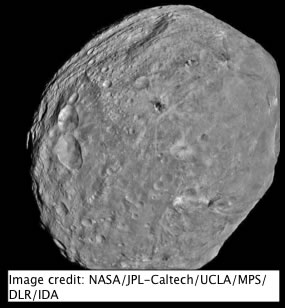 (2.8 billion km), the Dawn spacecraft entered orbit around the asteroid Vesta on July 16th (EDT). It marks the first time that a spacecraft has orbited a main belt asteroid.
Powered by an ion engine, Dawn has been gradually spiraling into a lower orbit from which it will conduct its science mission. The spacecraft will spend a year in orbit around Vesta before leaving for the larger asteroid (and dwarf planet) Ceres.
Vesta is the second most massive and brightest object in the asteroid belt. It is classified as a protoplanet due to its size (530 kilometers or 330 miles in diameter). The asteroid turns on its axis once every five hours and twenty minutes.
Juno
Carried into orbit on August 5th by an Atlas 5 rocket, the Juno spacecraft is on its way to Jupiter. Juno will arrive at Jupiter after completing a five year voyage that will involve a flyby of Earth in October 2013 for a gravity assist (that will increase the spacecraft’s velocity) before heading out to the gas giant. The four ton spacecraft is powered by three large solar arrays that were successfully deployed shortly after launch. This is the first solar-powered spacecraft to study the outer planets (previous spacecraft used nuclear radioisotope thermoelectric generators for power).
Juno will spend a year in orbit around Jupiter. By studying Jupiter, scientists hope to increase their understanding of how the planets formed in the solar nebula as well as gain a deeper insight into what lies below Jupiter’s cloud deck.
Aboard the spacecraft were three very unique LEGO 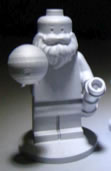 figurines: the Roman god Jupiter, his wife Juno, and "father of science" Galileo Galilei. The figurines are made out of aluminum rather than the traditional plastic. Joining the figurines for the trip is a plaque dedicated to Galileo that includes a reproduction of his observations of Jupiter in 1610.
As shown in the photo, Galileo is bringing along his telescope (credit: NASA/JPL-Caltech/KSC).
Check out the new Juno mission website at http://missionjuno.swri.edu/.
The Energizer Rover
On July 17th, after more than seven years exploring Meridiani Planum, Opportunity’s odometer passed the 20 mile mark. While hampered by a balky front wheel (that has the rover driving backwards) and shoulder joint (that prevents its arm from being stowed during travel), the rover continues to exceed expectations, covering more than 50 times the distance anticipated in its original 3-month long mission. 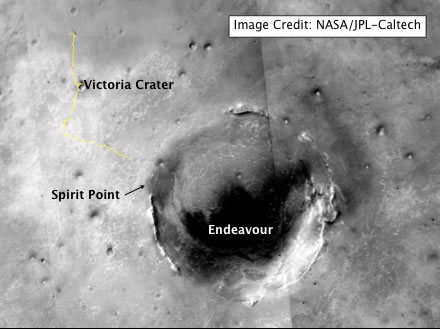
It’s been three years since Opportunity climbed out of Victoria crater and started on its long journey to the formidable Endeavour crater, approximately 13 miles to the southeast. Endeavour is about 14 miles (22 km) in diameter, far larger than anything previously encountered, and its deeper excavation has exposed potentially much older rock formations. Opportunity’s target was an outcropping of rock on the western rim, informally named Spirit Point (after Opportunity’s rover twin that is now inoperable).
On August 9th, Opportunity reached the rim of Endeavour crater. NASA had selected Endeavour as a target after the Mars Reconnaissance Orbiter detected signs of clay minerals around the crater's rim. It is believed that the clay minerals formed in a watery environment.
Curiosity
While Opportunity moved ever closer to its destination, NASA announced the preferred landing site for the next Mars rover. After winnowing down a list of 30 potential candidates to two, NASA announced on July 22nd, that Gale Crater would be the landing site of the Mars Science Laboratory (named Curiosity) in August 2012. 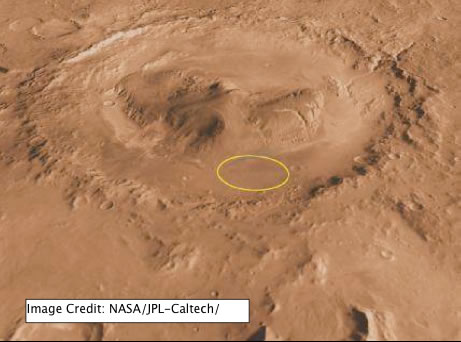
Named for Australian astronomer Walter F. Gale, the crater is 96 miles (154 km) in diameter. The rover will land at the base of a large mountain within the crater (the landing ellipse is shown on the photo in yellow). The layers of sediment at the base of the mountain suggest that water was involved in the formation.
Curiosity is scheduled to launch from Cape Canaveral in late November aboard an Atlas V rocket. The launch is currently scheduled for November 25th at 10:21 a.m. EST.
Mars Alert
In a news conference on August 4th, NASA announced that scientists have found new evidence of flowing water on the surface of Mars. The announcement was based upon detailed images from the Mars Reconnaissance Orbiter in which dark features (see arrows in photo) on the slopes at seven confirmed sites appear in the spring, fade in the winter, and reappear the next spring. The sites, located near the equator; are warm enough to permit a briny or salty solution to flow across the surface. An additional 20 more potential sites have been identified.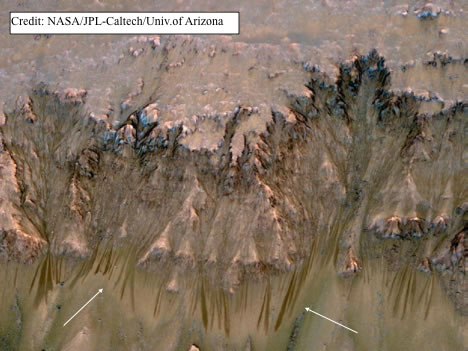
While not a confirmation of liquid water, the findings do support the possibility of near-surface reservoirs of liquid water. The presence of water would increase the likelihood of finding life of Mars, even if it is in a very primitive form.
The Lunar Grail
On September 8th, NASA is scheduled to launch its next lunar exploration mission. A Delta 2 rocket will carry two spacecraft from the Cape Canaveral Air Force Station in Florida into orbit.
The Gravity Recovery and Interior Laboratory (GRAIL) mission will study the moon's interior and evolution. The twin spacecraft, flying in a polar orbit, will map the Moon’s gravity in unprecedented detail. This information will be used to model the interior of the Moon and identify the processes involved in the formation of our natural satellite.
Another Moon for Dwarf Planet Pluto
Astronomers using the Hubble Space Telescope to look for rings around 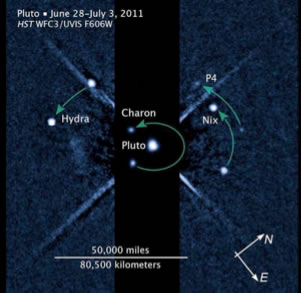 Pluto have discovered another moon orbiting the dwarf planet. Designated P4, the tiny moon is estimated to be 8 to 21 miles in diameter (13 to 34 km). It orbits Pluto every 31 days between the orbits of Nix and Hydra [that were also discovered by Hubble in 2005].
Mark Showalter, who led the Hubble observing program, has said that the name Cerberus (the three-headed dog that guarded the gates to the underworld) is the most commonly suggested name for P4 (the International Astronomical Union will make the final decision). Personally, I would prefer “Fluffy” (as a nod to Harry Potter fans).
First Trojan Asteroid Discovered in Earth’s Orbit
Astronomers have discovered the first known “Trojan” asteroid sharing Earth’s orbit around the Sun. The discovery was made with NASA’s Wide-field Infrared Survey Explorer (WISE) telescope and confirmed with the Canada-France-Hawaii Telescope on Mauna Kea in Hawaii.
Trojan asteroids share an orbit with a planet. They are typically located in gravitationally stable areas either in front of or behind the planet, so there’s little chance of collision. Trojans have been detected in the orbits of Mars, Jupiter and Neptune, but this is the first time that one has been found in Earth’s orbit.
The latest discovery, called 2010 TK7, is approximately 1,000 feet (300 meters) in diameter. It is located approximately 50 million miles (80 million km) from (and in front of) Earth. 2010 TK7 was detected because of its unusual motion that takes it well below and above the plane of Earth’s orbit.
Extreme Golf
Played all the great golf courses (professional or miniature) and looking for a new challenge? Thanks to the Cassini Imaging Central Laboratory for Operations (or CICLOPS), you can now play golf on the moons of Saturn.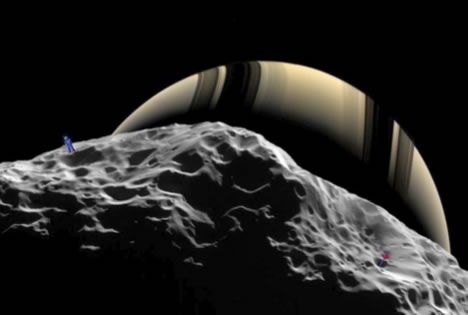
GOLF SECTOR 6 is a golf game that lets you tee off on 18 different moons of Saturn. The “course” is based upon the high resolution images returned by the Cassini spacecraft. All you have to do is select a trajectory and decide how hard to hit the ball toward the crater with a flag. Sounds simple until you realize that the gravity is different on each of Saturn’s moons, and, in most cases, much weaker than on Earth. Hit the ball too hard and it’s likely to go into orbit or completely escape from the moon altogether.
The snapshot below is of the moon Hyperion. The little blue spaceman is aiming for the red flag in the depression below the rocky outcropping. One of the smaller moons, Hyperion has a gravity field only 0.21% of Earth. It’s a PAR 4, but the first swing is the key to keeping your score low. To play a round, go to http://www.ciclops.org/sector6/golf.php.
Saturn’s moon Enceladus is the second hole on the front nine and was also the subject of August’s Second Saturday Star’s program. Here’s your chance to put to use what you learned to master this hole … watch out for the water jets around the south pole!
New Russian Radio Telescope
Russia launched a 33-foot (10 meter) diameter, dish-shaped radio telescope on July 18th. The reflector, comprised of 27 carbon fiber petals, needed to unfold and lock into place after launch. Despite some initial difficulties, the Russian Federal Space Agency announced a successful deployment of the orbiting observatory.
The radio telescope is placed in a highly elliptical orbit that extends almost to the distance to the Moon. The space-based telescope will work with ground-based facilities, such as the radio telescope at Arecibo in Puerto Rico, to detect faint radio signals from black holes and pulsars (collapsed stars) and other exotic objects. This technique is called interferometry. In interferometry, the resolution achieved is determined by the distance between the detectors (i.e., the individual telescopes act as one giant telescope with a diameter equivalent to distance between the individual telescopes).
The exceptional sensitivity from this arrangement could allow astronomers to resolve the event horizon around nearby black holes (the boundary area beyond which nothing, including light, can escape the black hole’s gravity). One of the primary targets of the radio telescope array will be the black hole at the center of the M87 galaxy. The event horizon around M87 is estimated to be as large as our solar system.
Launch of Goodrich Payload in Virginia Visible from Connecticut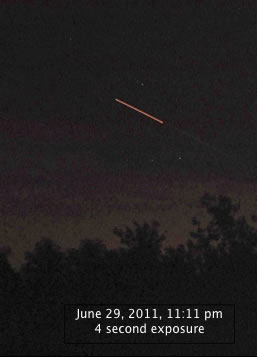
On the evening of June 29th, a steady reddish glow could be seen from a rocket rising out of the southern horizon before heading east and disappearing from view. The rocket, a Minotaur I, was launched from Wallops Island, Virginia. Its fiery exhaust was clearly visible from Connecticut despite several delays in the countdown and an increasing cloud cover.
The Minotaur family of rockets was developed by Orbital Sciences Corporation. A four-stage, solid-fueled launch vehicle, the Minotaur I uses re-commissioned motors from a Minuteman II ICBM for the first and second stages, along with Orbital Sciences’ own commercial boosters for the upper stages.
Liftoff occurred at 11:09 pm EDT. The spacecraft successfully separated from the rocket approximately 12 minutes later.
The spacecraft, designated ORS-1 (for Operationally Responsive Space-1), was placed in orbit at a 40 degree inclination to the equator, approximately 250 miles (400 km) above the Earth. Once declared operational by the Air Force, ORS-1 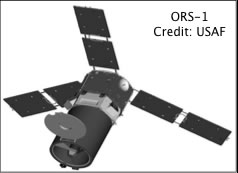 is designed to support combat command operations and anti-terrorist activities, providing detailed imagery of areas of concern such as Iran and Pakistan, as well as battlefield support in Afghanistan.
The heart of the 990 pound, quick-reaction spacecraft is an electro-optical reconnaissance system developed by Goodrich Corporation (the prime contractor) in Danbury. This highly sophisticated “camera” was derived from Goodrich’s imaging equipment installed on the U-2 reconnaissance aircraft. ORS-1 has an integrated propulsion module for orbital maneuvering and a design life of one year (or longer, depending upon fuel usage).
Return to Earth
On July 21, 2011, after 30 years and 135 missions, 21,152 orbits and 542,398,878 miles, the space shuttle era officially ended when Atlantis touched down on the runway at the Kennedy Space Center.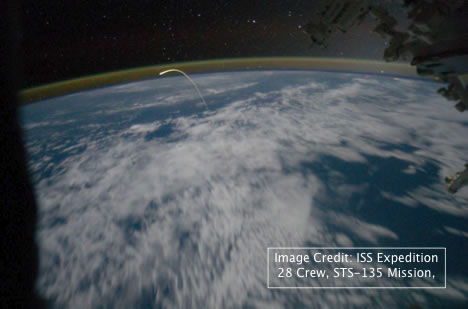
The photo (below) shows Atlantis’ fiery entry into the Earth atmosphere as viewed from the International Space Station, while the photo (next page) shows the subsequent landing at 5:57 am (EDT).
Harvest Moon
The full moon that occurs closest to the Autumnal Equinox is known as the Harvest Moon. This year the full moon occurs in the early morning of September 12th. The Harvest Moon traditionally appears around the time when farmers in the northern hemisphere are working long days to bring in their crops. The full moon provides a bit more light, longer into the evening. However, what is really special at this time of the year is the appearance of the Moon in the days just before and after it reaches its full phase.
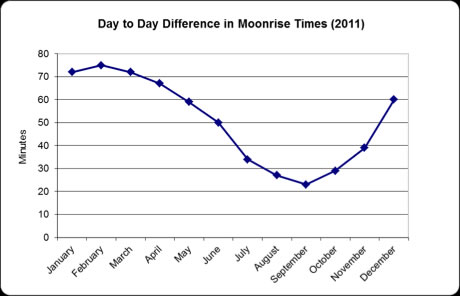
Throughout the year the Moon rises, on average, 50 minutes later each day. In September, on the days around the full moon, this difference is less than 30 minutes. On the graph (next page), the average difference in the time of moonrise on the three days preceding and following the full moon are plotted. In September, the difference is as little as 24 minutes (from one night to the next). The effect is that an almost fully illuminated moon is in the evening sky earlier each evening, benefiting farmers still out in the field (and children playing after school).
For example, the Moon rises at 5:55 p.m. on September 12th, the night of the full Moon. The next two nights the Moon rises 24 and 26 minutes later, respectively. As such, on the 14th, (two days after full) a bright moon is back in the sky less than an hour after sunset.
Autumnal Equinox
The Sun crosses the celestial equator at 5:04 am EDT on the morning of September 23rd, marking the beginning of the fall season in the northern hemisphere.
Aurora and the Equinoxes:
Geomagnetic storms that are responsible for auroras happen more often during the months around the equinox (March and September). Check your evening sky or log onto www.spaceweather.com for the latest on solar activity.
Sunrise and Sunset
Sun Sunrise Sunset
September 1st (EDT) 06:19 19:27
September 15th 06:34 19:03
September 30th 06:49 18:38
September Nights
Enjoy the jewels of the summer Milky Way while the nights are still warm and the skies are clear. From Cygnus to Sagittarius, follow the star clouds and dust lanes that comprise the inner arms of our spiral galaxy. In the south after sunset, the stars in the constellation Sagittarius form an asterism, or pattern, of a teapot. The spout of the teapot points the way to the center of the Milky Way galaxy with its resident black hole. Check out the July/August calendar for more details.
Present and Future Pole Stars
Vega, the fifth brightest star and located in the constellation Lyra, is placed high in the evening sky during September. Vega is also destined to become the Pole Star in 12,000 years. Precession, or the change in the direction of the rotational axis of the Earth over time, is best exemplified in a comparison of the position of Vega to that of Polaris (the current Pole Star).
Astronomical and Historical Events
1st History: flyby of Saturn by the Pioneer 11 spacecraft (1979)
2nd History: discovery of asteroid 3 Juno by Karl Harding (1804)
3rd Mercury at its greatest western elongation (separation) from the Sun (18°)
3rd History: controlled impact of the SMART-1 spacecraft on the lunar surface at the conclusion of a successful mission; precursor of NASA’s LCROSS mission (2006)
3rd History: Viking 2 spacecraft lands on the Martian surface (1976)
4th First Quarter Moon
5th History: launch of Voyager 1 to the planets Jupiter and Saturn (1977)
8th Scheduled launch of the Gravity Recovery and Interior Laboratory (GRAIL) lunar mission aboard a Delta 2 rocket from the Canaveral Air Force Station
8th History: sample return canister from the Genesis spacecraft crashes back to Earth when drogue parachute fails to deploy. Spacecraft was returning to Earth from Lagrange Point 1 with its collection of solar wind particles (2004)
8th History: first Star Trek episode airs on television (1966)
8th History: discovery of Comet Ikeya-Seki by Kaoru Ikeya and Tsutomu Seki (1965)
8th History: Marshall Space Flight Center's dedication by President Eisenhower (1960)
9th History: launch of Conestoga I, first private rocket (1982)
9th History: discovery of Jupiter’s moon Amalthea by Edward Barnard (1892)
9th History: launch of Soviet spacecraft Venera 11 (Venus lander) to the planet Venus (1978)
10th Second Saturday Stars – Open House at the McCarthy Observatory
10th History: debut flight of the Japanese H-2 Transfer Vehicle (or HTV) to the International Space Station (2009)
11th History: Mars Global Surveyor enters orbit around Mars (1997)
11th History: flyby of Comet Giacobini-Zinner by the International Cometary Explorer (ICE), first spacecraft to visit a comet (1985)
12th Full Moon (Full Harvest Moon)
12th Flyby of Saturn’s largest moon Titan by the Cassini spacecraft
12th History: launch of Soviet Luna 16; first robotic probe to land on the Moon and return a sample to Earth (1970)
12th History: launch of Gemini XI with astronauts Charles Conrad and Richard Gordon (1966)
Astronomical and Historical Events (continued)
12th History: launch of the Soviet spacecraft Luna 2, first to impact the Moon’s surface (1959)
13th Distant flyby of Saturn’s moons Pandora, Enceladus and Janus by the Cassini spacecraft
14th Distant flyby of Saturn’s moons Methone, Pallene and Telesto by the Cassini spacecraft
14th History: launch of Soviet spacecraft Venera 12 (Venus lander) to the planet Venus (1978)
14th History: discovery of Jupiter’s moon Leda by Charles Kowal (1974)
14th History: John Dobson born, father of the Dobsonian telescope (1915)
15th Moon at apogee (furthest distance from the Earth)
16th Distant flyby of Saturn’s moon Hyperion by the Cassini spacecraft
17th Asteroid 1 Ceres at Opposition (7.6 Magnitude) and closest approach to Earth (1.989 AU)
17th History: discovery of Saturn’s moon Mimas by William Herschel (1789)
18th History: launch of Vanguard 3, designed to measure solar X-rays, the Earth's magnetic field, and micrometeoroids (1959)
19th History: NASA unveiled plans to return humans to the moon (2005)
19th History: first launch of the Wernher von Braun-designed Jupiter C rocket from Cape Canaveral (1956)
19th History: discovery of Saturn’s moon Hyperion by William and George Bond and William Lassell (1848)
20th Last Quarter Moon
21st History: second flyby of Mercury by the Mariner 10 spacecraft (1974)
21st History: Gustav Holst born, composer of the symphony “The Planets” (1874)
21st History: Soviet spacecraft Zond 5 returns after circumnavigating the moon (1968)
21st History: Galileo spacecraft impacts Jupiter after completing its mission (2003)
22nd Scheduled launch of a Soyuz spacecraft from the Baikonur Cosmodrome in Kazakhstan to the International Space Station with members of the next Expedition crew
22nd History: Deep Space 1 spacecraft passes within 1,400 miles (2,200 km) of the 5 mile long potato-shaped nucleus of Comet Borrelly (2001)
23rd Autumnal Equinox, 5:04 am EDT
23rd Annual Connecticut Star Party, Ashford, CT, http://www.asnh.org (through the 25th)
23rd History: Johann Galle discovers the planet Neptune (1846)
24th History: John Young born (1930), first person to fly in space six times, including Gemini 3 (1965), Gemini 10 (1966), Apollo 10 (1969), Apollo 16 (1972), STS-1, the first flight of the Space Shuttle (1981), and STS-9 (1983)
24th History: Soviet spacecraft Luna 16 returns 101 grams of lunar soil to Earth (1970)
25th Uranus at Opposition (rising with the setting Sun and visible all night)
26th History: Cosmonauts V. Titov and Strekalov escape moments before Soyuz T-10-1 explodes on the pad (1983)
27th New Moon
27th Moon at perigee (closest distance to Earth)
27th History: launch (2007) of the Dawn spacecraft to Vesta (2011) and Ceres (2015)
27th History: launch of SMART-1, the first European lunar probe (2003)
28th Distant flyby of Saturn’s largest moon Titan by the Cassini spacecraft
28th History: launch of Soviet lunar orbiter Luna 19; studied lunar gravitational fields and mascons (mass concentrations), radiation environment, and the solar wind (1971)
28th History: launch of Alouette, Canada's first satellite (1962)
28th History: discovery of Jupiter’s moon Ananke by Seth Nicholson (1951)
Astronomical and Historical Events (continued)
29th History: second launch of SpaceShipOne (2004)
30th Distant flyby of Saturn’s largest moon Titan by the Cassini spacecraft
30th History: all instruments deployed on the Moon by the Apollo missions are shut off (1977)
30th History: discovery of Jupiter’s moon Themisto by Charles Kowal (1975)
All other non-credited photos were taken by the author: Bill Cloutier
Cover Photo
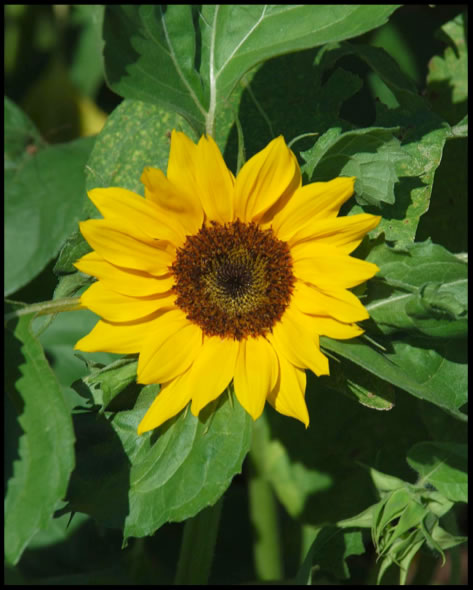
One of a multitude of sunflowers in bloom in Galileo’s Garden at the McCarthy Observatory
(the sunflowers were planted by students at New Milford’s three elementary schools)
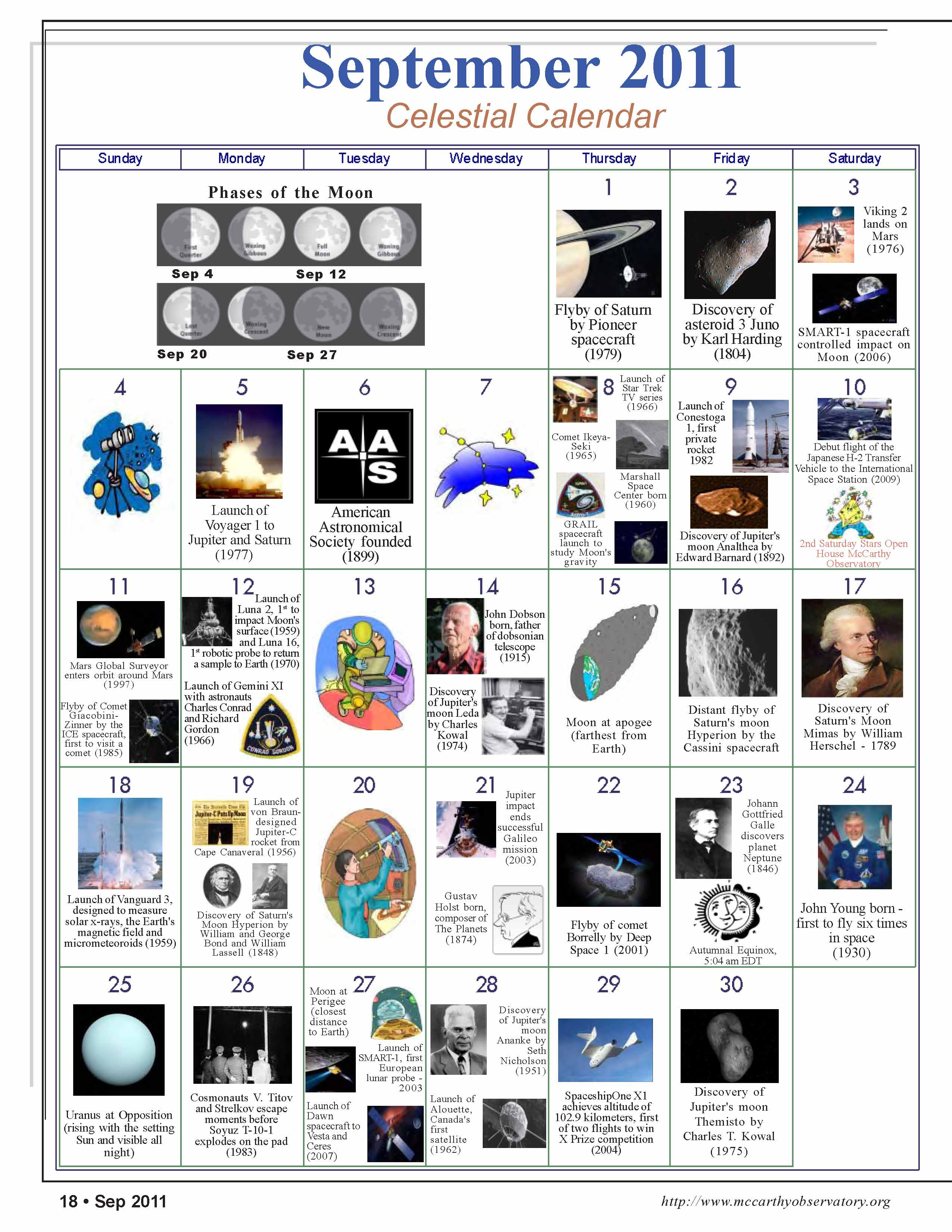
====
[right-click on calendar to download a bigger image.]
Come and see the Scale Solar System spread throughout New Milford! Start with the Sun at the Observatory and go from there. Walk at 15.5 inches per second (roughly one step) and get to earth at the scale speed of light! (~8 minutes)
References on Distances
The apparent width of the Moon (and Sun) is approximately one-half a degree (½°), the width of your little finger at arm’s length; three fingers is approximately five degrees (5°)
1 astronomical unit (AU) is the distance from the Sun to the Earth or approximately 92,955,778 million miles
1 light year (ly) is the distance light travels (at 186,282.3394 miles per second) in one year or approximately 5,874,599,855,946.53417 trillion miles or 63,197.7912 AU. 3.26 LY = 1 parallax second or (1 parsec)
International Space Station/Space Shuttle/Iridium Satellites
Visit www.heavens-above.com for the times of visibility and detailed star charts for viewing the International Space Station, the Space Shuttle and the bright flares from Iridium satellites.
Solar Activity
For the latest on what’s happening on the Sun and the current forecast for flares and aurora, check out www.spaceweather.com.