


- M13 cluster
- Flame neb
- Dumbbell neb
- Dumbbell neb
- Horsehead neb
- asteroid Hermes
- Saturn 2003
- Ring neb
- asteroid WT24
- Solar
- Jupiter 2004
- NEAT
- NGC 2903
- Orion neb
- M51

|
This image of the Great Cluster in Hercules, M13, was taken with a Canon Digital
Rebel camera. Thirty 30 second images were stacked with a dark frame to get this
composite of about 15 minutes exposure. Imaged by Josh Reynolds. |
Flame nebulae in Orion

|
The Flame nebulae is also impressive. It resides in Orion near the left star in Orion's belt. This was stacked using the SBIG ST10xe for about 45minutes to compile this mosaic of 4 frames. Credit J Reynolds JJMO |
| Image of of the Dumbbell nebula taken using a Canon digital Rebel. It is a stack of 10, 4 minute images at the prime focus of the observatory's 16 inch Meade LX-200. Dark frames were subtracted from each image resulting in a total of 40 minutes of light being captured. Image taken by Josh Reynolds. | 
|
Dumbbell Nebula

|
An LRGB image of the Dumbbell Planetary Nebula in the constellation Vulpecula. Located 980 light years from earth. Taken with the ST-10 and the 16" Meade SCT through a series of color filters. 5 minute exposures for luminance, Red and Green. And 10 minutes for Blue. Processed and combined in Maxim DL. Date: 7/10/04 Imaged by Dennis Cartolano |
Horsehead Nebula
| The Horsehead Nebula in Orion is an especially dim dark nebula that projects into the bright nebula, IC 434 near Zeta Orionis. It is also classified as Barnard 33. To see it visually, the viewer needs an especially dark sky to view it properly. The New Milford High School Astronomy club used the JJMO 16 inch telescope and the ST-10 CCD imager with 0.6 focal reducer to capture this especially clear image of the Horsehead. LRGB images were taken at 1 x 1 binning and stacked. |

|
Asteroid Hermes - Imaged 10/16/2003
|
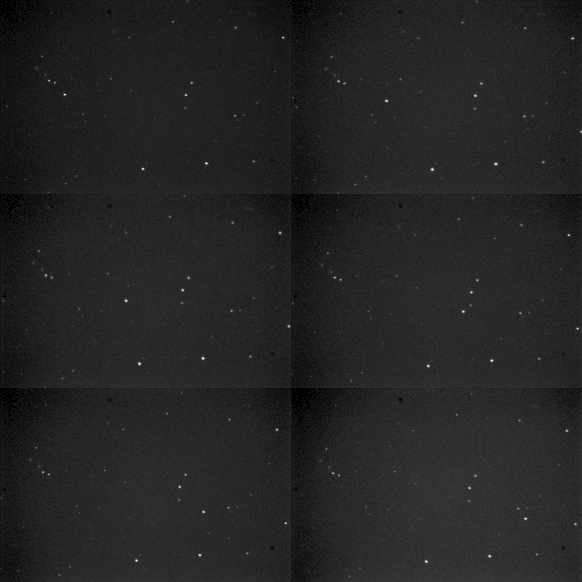
An animation of Asteroid Hermes, imaged at JJMO on October 25, 2003 as it moved through the constellation Cetus. At the time it was at a distance of about 10 million miles from Earth on its way to a close approach of 4.4 million miles on November 4th. The animation spans two hours. Hermes is a potentially hazardous, near earth astroid, discovered in October, 1937 from Heidelberg by K. Reinmuth. In 1937 it came just twice as far as the moon from us. It was then lost and not observed again until October 15, 2003, by Lowell Observatory astronomer, Brin Skiff. Hermes has an orbital period of 777 days. Radar observations during its 2003 close approach have determined that Hermes is a binary asteroid, not one but two objects! |
Saturn From the Web Cam
| This image was compiled by Dennis Cartolano on December 1, 2003 and represents a selection of stacked images taken with his ToUCam with the 16" telescope and 2x Barlow. |

|
Ring Nebula (M57)

|
An amazing object for sure, and one of the top 5 nebula’s that amateur astronomers try to discern through their telescopes. The Ring Nebulae or M57 (Messier object # 57) is what happens to a star about the mass of our own sun that nears the end of its life. The ring is actually the result of the star essentially blowing up propelling its gaseous shell outward at approximately 16.5 miles per second. We are viewing this object, which is 1100 light years away, and the event occurred about 20,000 years ago. In about 5 billion years our own sun will meet the same fate. Image by JR using Takahashi 106 SBIG ST10 |
Asteroid 1998 WT-24
| This image is an animation of the actual data collected by Randy Fender of the asteroid 1998 WT-24 during its near earth approach (5 lunar distances [LD] from us - approximately 1,250,000 miles) on December 16, 2001. The images which make up this animation were captured using the Meade 16 inch telescope using the facilities ST7 digital camera. The images were captured using 4 second exposure times, spaced at intervals of approximately 30 seconds. This means that the entire sequence represents about 6 minutes in real time. |

|
Solar Image Taken at JJMO

|
This is a recent image taken of the Sun through the JJMO Helios telescope and captured by our ST7 digital imaging camera. This image was taken as a part of the solar studies ongoing at the observatory. Note that the sun spot designations are indicated on the image in red. The image was captured and processed by Monty Robson. |
Jupiter May 5th 2004
| Jupiter imaged with the ToUCam webcam. A 2x Barlow lens was used with the 16" Meade SCT @ a focal length of nearly 8000mm. A small video of 2 minutes was taken consisting of over 1100 individual frames. Each frame was inspected and only the sharpest ones were used in the stacking process. More than 500 frames were used in this final image. Image taken by Dennis Cartolano |

|
2001Q4 NEAT

|
Comet NEAT imaged with the ST-10 and the 106mm Takahashi on May 15th 2004. Image is a composite of 7 images aligned and stacked in Maxim DL. Image taken by Dennis Cartolano |
NGC 2903
|
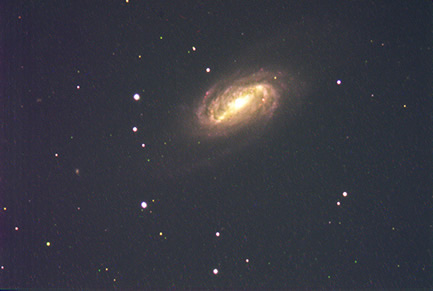
Spiral galaxy NGC 2903 in Leo was taken with the SBIG ST10xe camera on the 16 inch telescoope. It was stacked using about 20 2min images. Credit J Reynolds JJMO |
Great nebula in Orion
|
This is perhaps the most famous object in the night sky. It was taken with the SBIG ST10e and the Takahashi 4in scope. Image uses about 2 hrs of stacked frames. Image byJ Reynolds JJMO The close up is from a stack of 20 20second and some 40second exposures through color filters with the ST10e camera on the 16 inch. Image by J Reynolds JJMO
|


Whirlpool galaxy
|
This is the Whirlpool Galaxy M-51 in Canis Venatici and is a great face-on view of two galaxies interacting. This was taken at JJMO using about an hour of clear/luminance, OIII, and Hbeta filters on the ST10E camera. |
